Mountain facts
Kilimanjaro's 5 Climate Zones: From Rainforest to Arctic Summit
Kilimanjaro has five climate zones: cultivated land, montane rainforest, heath and moorland, alpine desert and the arctic summit. Each spans roughly 1,000 m of height, so TANAPA, the park authority, compares the climb to a trip from the equator to the Arctic.
On our Machame and Lemosho routes you start at the rainforest and climb through every zone above it. Here are the altitudes, the weather and what you'll see in each one. The mountain itself is a volcano: see Is Kilimanjaro a volcano?. The snow and ice in the highest zone are in Does Kilimanjaro have snow?. For how the park began, see Kilimanjaro history.
- 6Small groups of 6 climbers, max
- ✓Locally owned and operated in Tanzania
- ▲Higher Kosovo summit camp for a better summit chance
- ★Authentic Africa, from summit to safari
Most Recommended Locally Owned Company on TripAdvisor · 1,600+ verified reviews · Summiting Kilimanjaro since 1984
Overview
What are the 5 climate zones on Kilimanjaro?
| Zone | Altitude (approx.) | Climate | What you see |
|---|---|---|---|
| Cultivated land | 800–1,800 m | Warm and farmed | Villages, coffee, bananas and maize on the lower slopes |
| Montane rainforest | 1,800–2,800 m | Wettest zone; rain peaks around 2,200 m | Tall forest, moss, blue and colobus monkeys |
| Heath and moorland | 2,800–4,000 m | Cooler and misty; frost is possible | Giant lobelias, giant groundsels and heather |
| Alpine desert | 4,000–5,000 m | Dry, strong sun, big swings between day and night | Rock, gravel and small cushion plants |
| Arctic summit | 5,000 m and up | Below freezing; average yearly temperature about −7°C at Uhuru | Scree, glaciers and ice cliffs |
Zones 1 and 2
What is the rainforest zone like on Kilimanjaro?
The lower slopes, up to about 1,800 m, are farmland and villages. Britannica lists coffee, bananas and maize among the crops grown in the region. You pass through on the drive to the gate.
Above that, a wide band of montane forest circles the whole mountain from about 1,800 to 2,800 m (TANAPA). It is the wettest part of Kilimanjaro: a 2015 study in PLOS One found rainfall peaks at around 2,200 m. Look for blue monkeys and black-and-white colobus monkeys, and TANAPA notes endemic plants such as Impatiens kilimanjari. See our guide to wildlife on Mount Kilimanjaro.
On the 7-Day Machame you start at Machame Gate (1,640 m) and walk up through the forest on day 1. On the 8-Day Lemosho you start higher, at Londorossi Gate (2,360 m). Both routes come back down through the forest to Mweka Gate on the last day.
Zone 3
What is the heath and moorland zone?
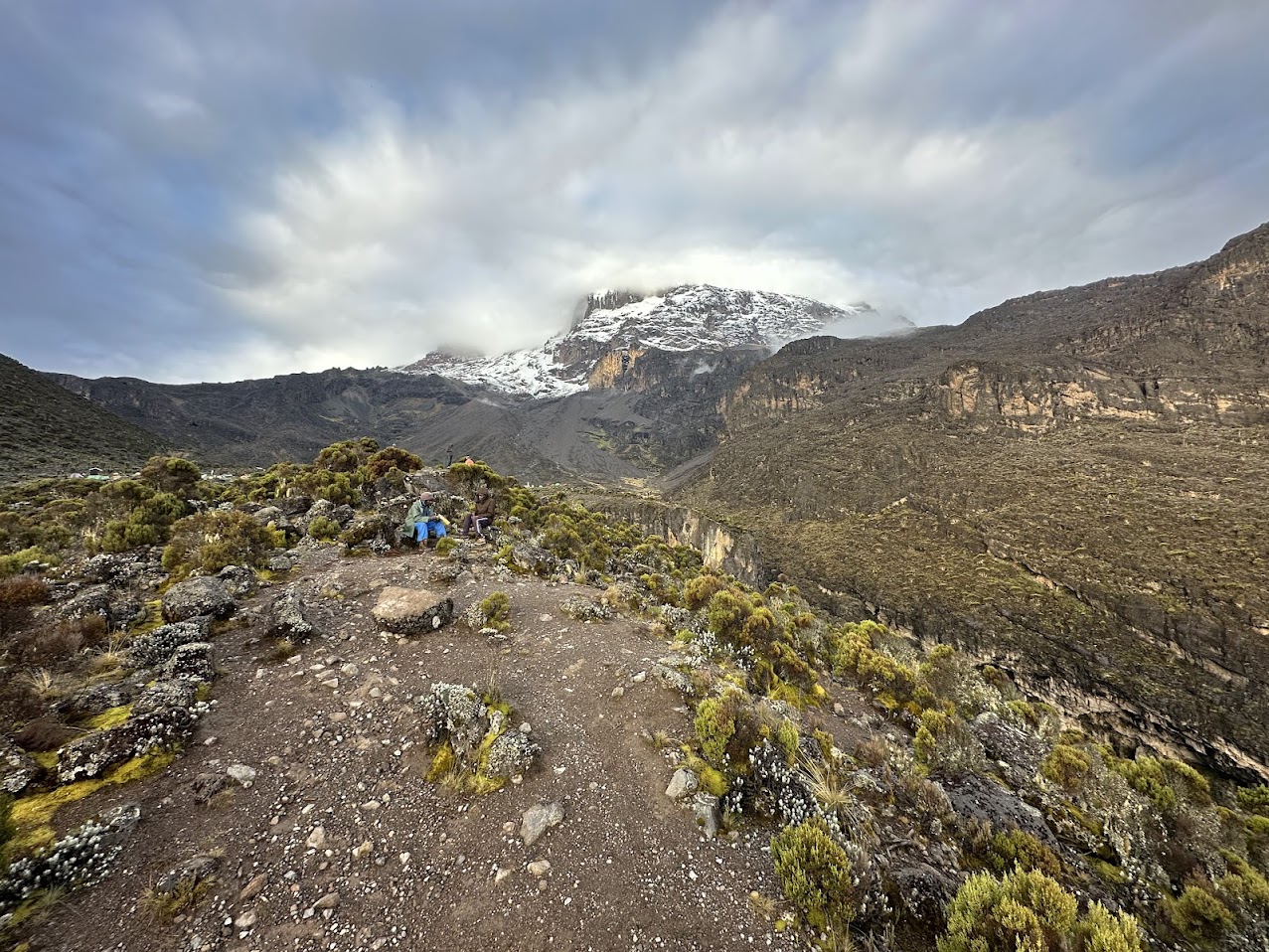
From about 2,800 to 4,000 m the forest gives way to heath and moorland (NASA Earth Observatory). The air is cooler and drier, mist can roll in quickly, and frost is possible at night. This is where you see Kilimanjaro's famous giant plants: the giant lobelia and the giant groundsel (Britannica).
On both of our routes, days 2 and 3 cross this zone, with big views of Kibo's snowy summit.

Zone 4
What is the alpine desert zone?
Above about 4,000 m, plants become scarce. Small cushion plants and tussock grasses reach to around 4,500 m (PLOS One), and then it is mostly rock and gravel. Days are bright and the sun is strong, and nights are cold.
Both routes climb to Lava Tower (4,630 m) in this zone and then drop to camp lower down, which helps your body acclimatize. Our high camp before summit night is here too; read about the Kosovo Camp advantage.
Zone 5
What is the arctic summit zone like?
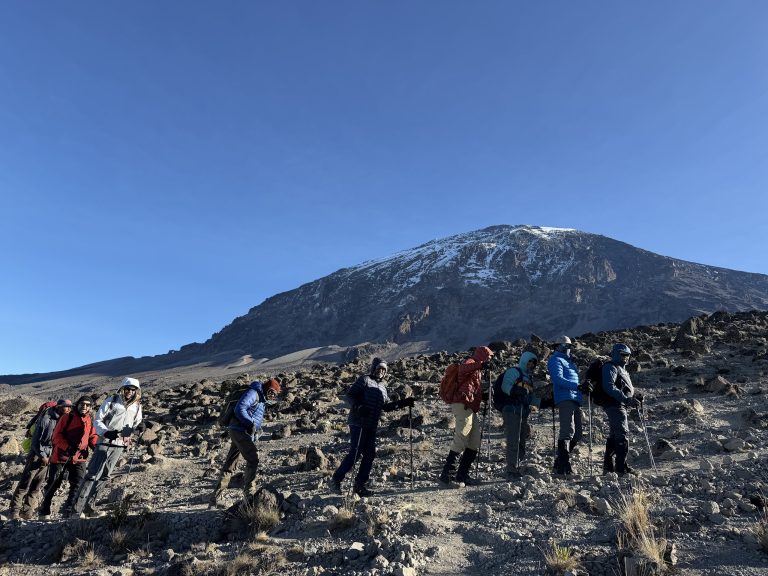
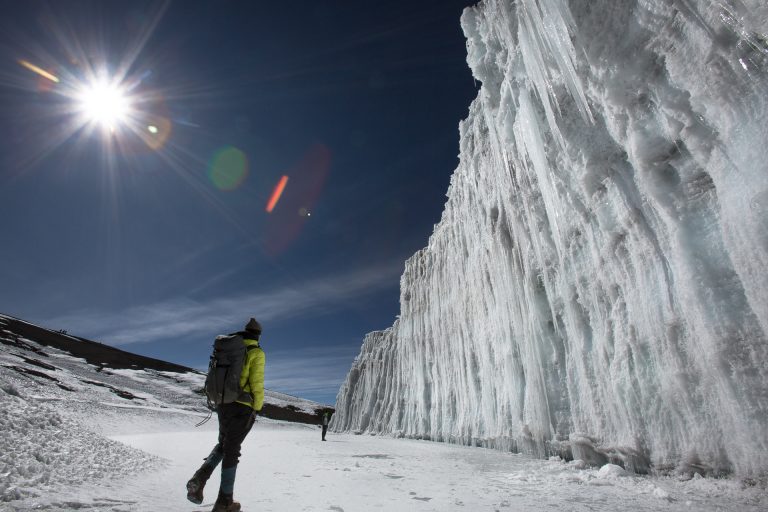
Above about 5,000 m you are in the arctic zone: scree, rock and ice. The PLOS One study puts the average yearly temperature at Uhuru Peak at about −7°C, and on summit night it can drop to −20°C (−4°F) or colder. See how cold Kilimanjaro gets.
You reach this zone on summit night, arriving at Stella Point (5,750 m) on the crater rim around dawn and then walking on to Uhuru Peak (5,895 m), past the glaciers. Read what to expect on summit night.
Packing
What do the climate zones mean for what you pack?
Because you pass through warm forest and arctic cold on the same trip, you need layers, not one heavy outfit. Expect to start in a T-shirt and rain jacket and finish summit night in every warm layer you brought.
- A waterproof jacket and pants for the rainforest and moorland mist
- Sun protection for the alpine desert: hat, sunglasses and sunscreen
- Warm layers, a down jacket, gloves and a warm hat for summit night
- A sleeping bag rated to 0°F (about −18°C), which you can also rent from us
See our full packing essentials.
Have a question this page doesn't answer? Our Kilimanjaro FAQs cover booking, gear, safety, visas and more, or ask us directly.
Tiffany Watson · Operations Director
Walk from rainforest to glacier
Our 7-Day Machame and 8-Day Lemosho climbs cross all five zones with small groups of six. Ask us which route fits you.
Or call 1-888-589-1884 · Email us
Where this comes from: Zones and altitudes: TANAPA park brochure (2024); NASA Earth Observatory; PLOS One (2015) study of Kilimanjaro's vegetation zones; Encyclopaedia Britannica. Gate, camp and summit heights: our 7-Day Machame itinerary and 8-Day Lemosho itinerary. Summit temperatures: how cold Kilimanjaro gets. Sleeping bag rating and rentals: our FAQs.