

Mountain history
Kilimanjaro History: The First Ascent, the Name and the National Park
The first recorded ascent of Kilimanjaro's summit was in 1889, by German geographer Hans Meyer and Austrian mountaineer Ludwig Purtscheller. Europeans first learned of the mountain in 1848, it became a national park in 1973, and UNESCO named it a World Heritage Site in 1987.
The mountain itself is far older: its volcanoes began forming about 2.5 million years ago (see Is Kilimanjaro a volcano?). Here is the human story, from the first reports of snow on the equator (see Does Kilimanjaro have snow?) to Kilimanjaro National Park today, climbing through Kilimanjaro's climate zones.
- 6Small groups of 6 climbers, max
- ✓Locally owned and operated in Tanzania
- ▲Higher Kosovo summit camp for a better summit chance
- ★Authentic Africa, from summit to safari
Most Recommended Locally Owned Company on TripAdvisor · 1,600+ verified reviews · Summiting Kilimanjaro since 1984
Timeline
Kilimanjaro history at a glance
- About 2.5 million years agoVolcanic activity begins at Shira, the oldest of Kilimanjaro's three cones. Read Is Kilimanjaro a volcano?.
- 1848German missionaries Johannes Rebmann and Johann Ludwig Krapf reach the region. Their reports of snow so close to the equator are not believed in Europe for more than a decade.
- 1889Hans Meyer and Ludwig Purtscheller reach the summit of Kibo, the first recorded ascent.
- 1910The mountain becomes a game reserve under the German colonial government.
- 1921The forests are made a forest reserve.
- 1961Tanganyika becomes independent, and the summit is named Uhuru Peak, "freedom" in Swahili.
- 16 March 1973Kilimanjaro National Park is established, covering 756 km² at first.
- 1977The park officially opens for tourism, opened by Julius Nyerere.
- 1984Climb Kili begins summiting Kilimanjaro.
- 1987UNESCO lists Kilimanjaro National Park as a World Heritage Site.
- 2005The park is expanded to take in the montane forest, growing to 1,712 km².
- 2013Kilimanjaro is named one of the Natural Wonders of Africa.
First ascent
Who was the first person to climb Kilimanjaro?
The first recorded ascent of Kibo, Kilimanjaro's summit cone, was made in 1889 by the German geographer Hans Meyer and the Austrian mountaineer Ludwig Purtscheller (Britannica).
The mountain was well known to the people who lived on its slopes long before that. Britannica lists the Chaga (Chagga), Pare, Kahe and Mbugu peoples in the Kilimanjaro region, and the town of Moshi, at the mountain's southern foot, is still the main base for climbs.
Today, as Britannica notes, Kibo's summit can be reached without mountaineering equipment, which is why thousands of hikers attempt it every year.
The name
What does the name Kilimanjaro mean?
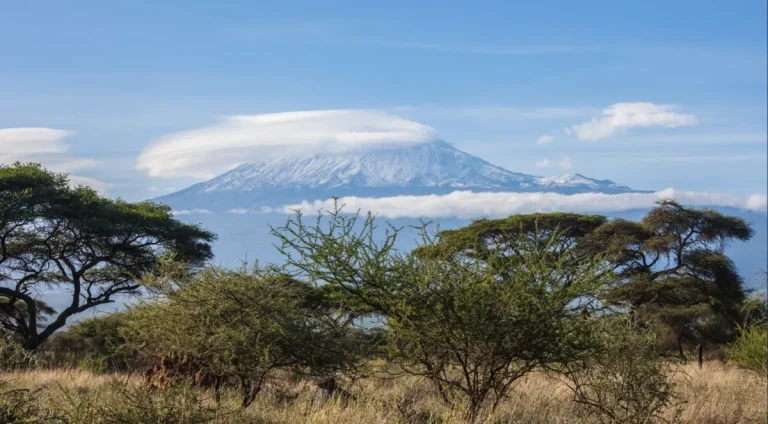
No one knows for certain. The first part is easy: kilima means "hill" or "small mountain" in Swahili.
The second part, -njaro, is the puzzle. The explanation you will see most often is a word meaning "shining" or "white", a fitting name for a snow-capped peak. UNESCO's Japanese-language description of the park gives this reading and attributes njaro to the Maasai language. Other theories exist, and none is proven.
Many climbers pick up a few Swahili words on the mountain. Start with our list of Swahili words for climbers.
Uhuru Peak
How did Uhuru Peak get its name?
Uhuru is Swahili for "freedom". During the colonial era the summit carried a German name, Kaiser-Wilhelm-Spitze. When Tanganyika (now mainland Tanzania) became independent in 1961, the highest point in Africa was renamed Uhuru Peak (DW).
At 5,895 m (19,341 ft), it is the point every climber is aiming for. Read our full guide to Uhuru Peak.
The park
How did Kilimanjaro National Park begin?
The mountain was protected in stages. It was made a game reserve in 1910 and a forest reserve in 1921, and on 16 March 1973 Tanzania established Kilimanjaro National Park, covering the mountain above the tree line and six forest corridors (TANAPA; UNESCO). It opened to tourism in 1977.
UNESCO added the park to its World Heritage list in 1987, and in 2005 the park was enlarged to include the mountain's natural forest, bringing it to 1,712 km². Read what the park is like today in our guide to Kilimanjaro National Park.
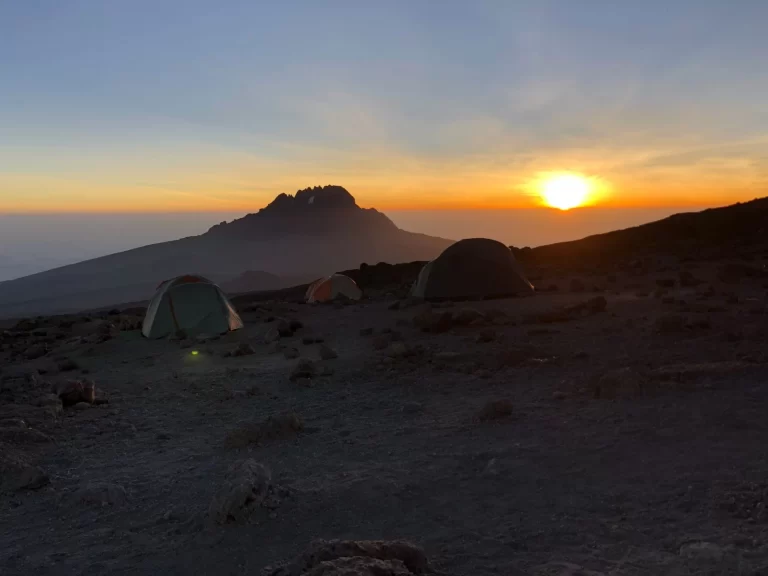
Today
Climbing Kilimanjaro today
Today every climber must go with a licensed guide through a registered operator, and around 50,000 people attempt the mountain each year (our Kilimanjaro facts guide).
Climb Kili has been summiting Kilimanjaro since 1984. We are locally owned and operated in Tanzania, and we climb two routes we know well: the 7-Day Machame and the 8-Day Lemosho.

Have a question this page doesn't answer? Our Kilimanjaro FAQs cover booking, gear, safety, visas and more, or ask us directly.

Tiffany Watson · Operations Director
Add your name to Kilimanjaro's story
Small groups of six, local guides and a higher summit camp. Ask us about 2027 dates on the Machame and Lemosho routes.
Or call 1-888-589-1884 · Email us
Where this comes from: History, first ascent, peoples and crops: Encyclopaedia Britannica. Park dates and size: TANAPA Kilimanjaro National Park 50th anniversary magazine; TANAPA Northern Zone Quick Reference (2024); UNESCO World Heritage Centre. Volcano age: Nonnotte et al. (2008), Journal of Volcanology and Geothermal Research. The name: UNESCO World Heritage Centre (Japanese-language description). Uhuru Peak naming: DW. Climber numbers and guide rules: our Kilimanjaro facts guide and FAQs.